
Architecting a White-Label Mobile Application Framework
Guwanch
Mobile Developer
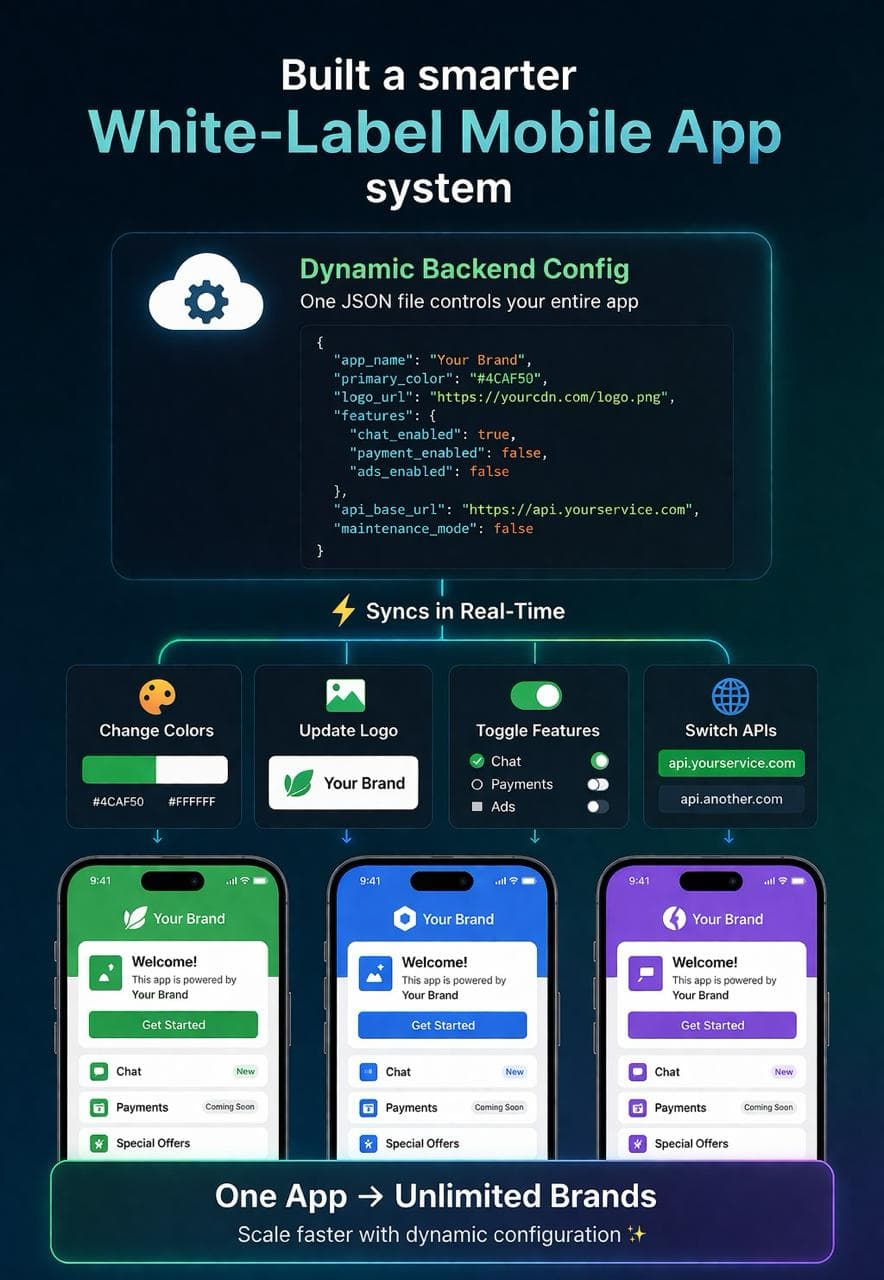
A deep dive into building a configuration-driven mobile app architecture that enables seamless multi-brand deployment from a single codebase — eliminating redundancy and accelerating time-to-market.
In modern product development, scalability is not just a technical consideration — it is a business imperative. When tasked with serving multiple clients under distinct brand identities, the conventional approach of maintaining separate codebases quickly becomes unsustainable. To address this, I designed and implemented a White-Label Mobile Application framework built around a centralized, configuration-driven architecture.
At its core, the system is governed by a single JSON configuration file that acts as the single source of truth for every client deployment. This file encapsulates all variant-specific parameters, allowing the application to adapt dynamically without requiring any changes to the underlying source code.
The configuration schema is structured across five primary domains:
→ Identity: Application name, icon assets, and splash screen visuals.
→ Aesthetics: Brand color palettes, typography definitions, and theme variants.
→ Feature Flags: Granular toggles for capabilities such as in-app messaging, payment gateways, and advertising modules.
→ Infrastructure: Environment-specific API endpoint routing for development, staging, and production.
→ Operations: Maintenance mode orchestration and version management controls.
The Architectural Advantage
The impact of this approach extends well beyond code cleanliness. By decoupling brand identity from application logic, the framework delivers measurable business value:
- Operational Efficiency: A single build pipeline serves all clients, eliminating the overhead of parallel development tracks.
- Simplified Maintenance: Bug fixes, performance improvements, and feature updates propagate universally — no client is left on a stale version.
- Rapid Onboarding: Deploying a new brand requires only a new configuration file, reducing launch timelines from weeks to hours.
- Controlled Feature Rollout: Capabilities can be enabled or disabled per client at runtime, without requiring a new release.
For organizations building SaaS platforms or managing multi-tenant mobile products, this configuration-driven pattern represents a significant architectural investment with compounding returns. It positions your codebase to scale horizontally across clients while remaining vertically maintainable by a lean engineering team.