
Eliminating API Boilerplate in Flutter with OpenAPI Generator
Guwanch
Mobile Developer
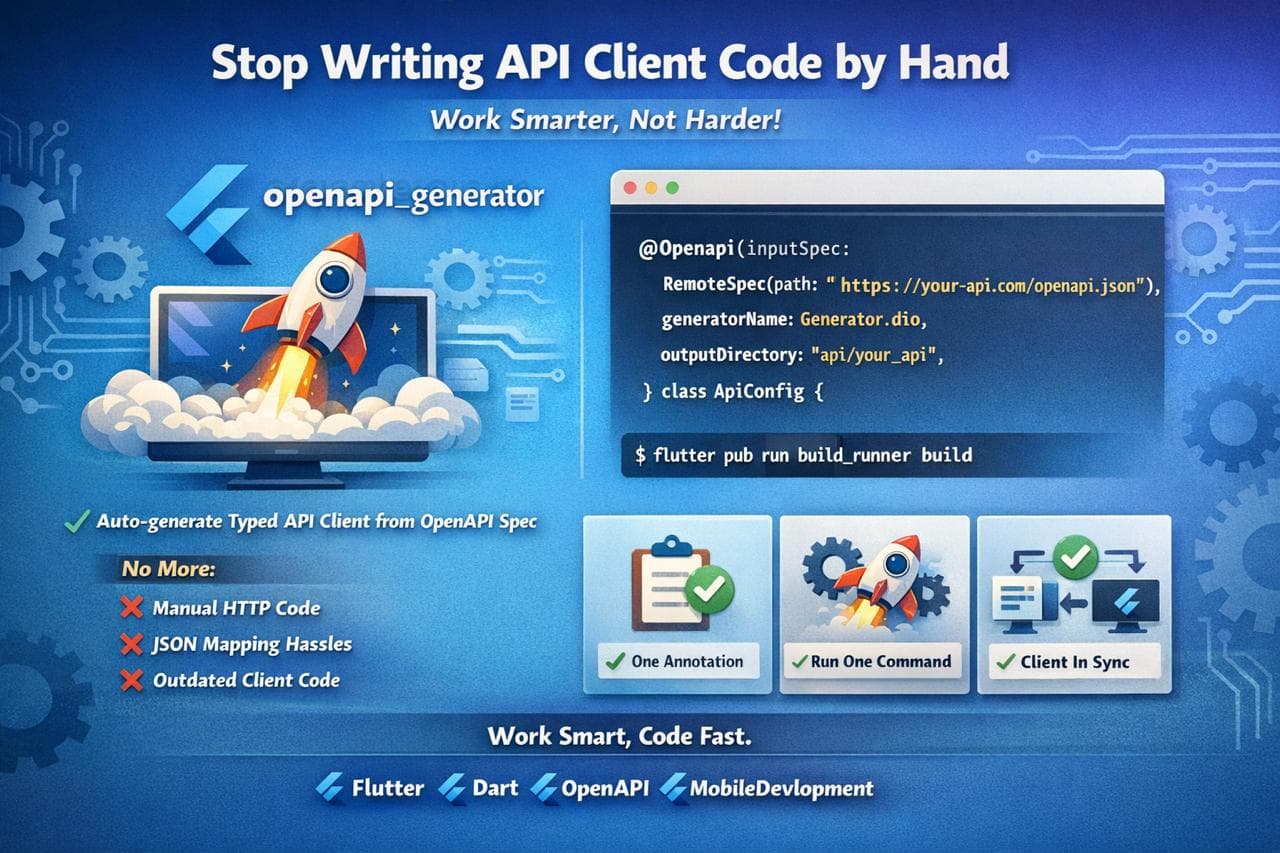
A practical guide to automating REST API client generation in Flutter using the openapi_generator package — saving hours of manual work while keeping your client code perfectly synchronized with backend contracts.
One of the most persistent sources of technical debt in Flutter development is the manual maintenance of API client code. As backends evolve, keeping Dart models, HTTP logic, and endpoint definitions in sync becomes a fragile, time-consuming process prone to human error. The openapi_generator package offers a principled solution: derive your entire API client directly from your OpenAPI specification.
How It Works
The package integrates natively with Flutter's build_runner system. Given an OpenAPI specification — whether hosted remotely or stored locally — it automatically generates a fully typed, production-ready Dart client, complete with data models, serialization logic, and endpoint abstractions.
→ Consumes a local or remote OpenAPI specification file.
→ Produces a strongly typed Dart/Flutter API client.
→ Integrates seamlessly into the existing build_runner pipeline.
What This Eliminates
- Hand-written HTTP request and response handling.
- Manual JSON serialization and deserialization.
- The ongoing effort of keeping client code aligned with backend schema changes.
A minimal configuration is all that is required to get started:
@Openapi(
inputSpec: RemoteSpec(path: 'https://api.example.com/spec.json'),
generatorName: Generator.dio,
outputDirectory: 'api/your_api',
)
class ApiConfig {}
Running the following command triggers the generation process:
`flutter pub run build_runner build`
Production Considerations
Through practical experience, a few configurations prove especially valuable in real-world projects:
- Leverage .openapi-generator-ignore to safeguard files that contain custom, manually authored logic from being overwritten on subsequent generations.
- Apply dependency_overrides in the generated pubspec.yaml to resolve version conflicts without modifying the generated output directly.
- Keep skipIfSpecUnchanged: true (the default) enabled to ensure regeneration only occurs when the specification has actually changed, preserving build performance.
The most significant benefit emerges over time: when the backend team updates the API contract, a single command is sufficient to bring the client into full alignment. No manual review of changed endpoints, no risk of missed fields — just a reliable, automated synchronization between your mobile application and its backend services.